
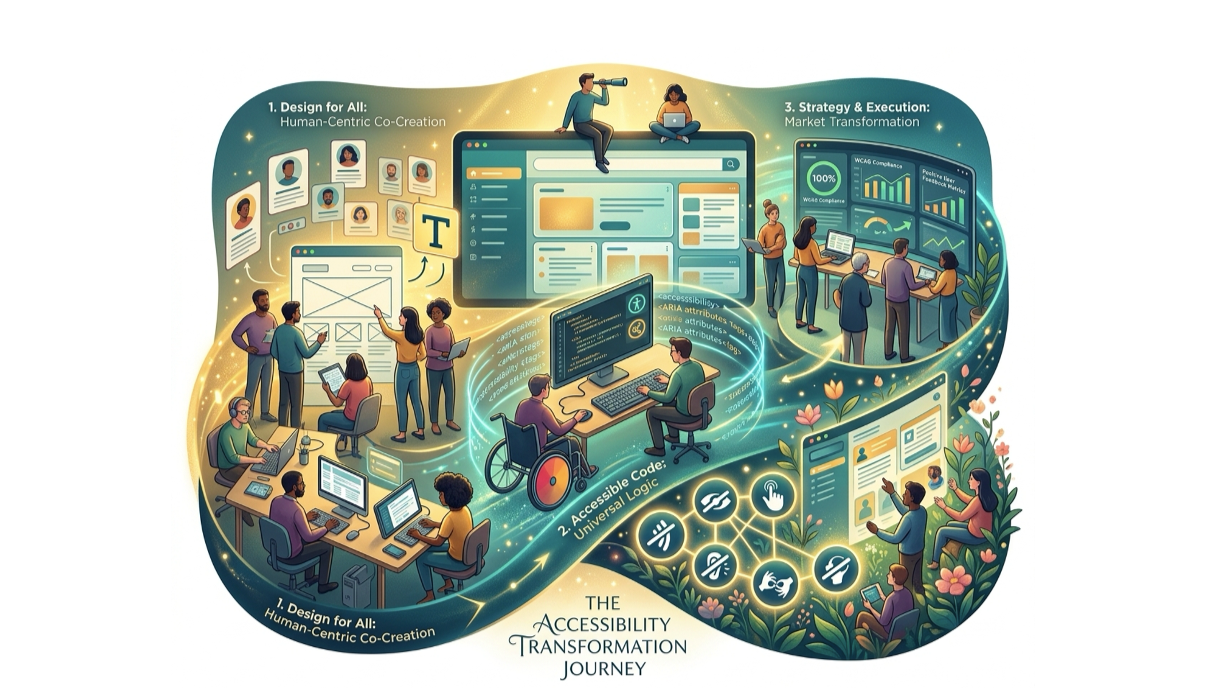
The C-Suite Blind Spot: Seeing Accessibility as Cost and Compliance — While Ignoring a $13 Trillion Market
June 11, 2026

Harish Beeram
Architecting innovative & disruptive software UI/UX solutions with a focus on digital accessibility and Human Centered Design based transformation | Entrepreneur | Author | Investor | TEDx Speaker | Low Vision person
Here is what I’ve witnessed consistently:
When accessibility reaches the executive leadership table — when it gets discussed at all — it is almost always framed through two lenses only:
- Compliance — “Are we meeting ADA requirements? Are we WCAG 2.1 AA conformant? What’s our litigation exposure? Have we checked the box?”
- Cost — “How much will remediation cost? What’s the budget impact? Can we defer this to next quarter? Can we do the minimum to reduce legal risk?”
These are not wrong questions. Compliance matters. Legal risk is real. Cost management is a fiduciary responsibility.
But these two lenses alone create a catastrophic blind spot.
When leadership sees accessibility exclusively through the lens of compliance and cost, they are making a fundamental strategic error. They are looking at the expense column while completely ignoring the revenue column. They are managing downside risk while being entirely blind to upside opportunity.
And the opportunity is not small. It is staggering.
The Numbers That Should Be on Every Board Presentation
Let me put this in the language that C-level executives, board members, and investors understand — the language of market size, revenue opportunity, and competitive advantage:
- 1.3 billion people globally live with some form of disability. That is approximately 16% of the world’s population. That is not a niche. That is not an edge case. That is one in every six human beings on the planet.
- The global disability market controls over $13 trillion in annual disposable income when you include the spending influence of friends and family (the “disability economy” or “purple pound/purple dollar”).
- In the United States alone, 61 million adults — 26% of the adult population — live with a disability. Their combined discretionary spending power exceeds $490 billion annually.
- The aging population is the fastest-growing demographic globally. By 2050, the number of people aged 60+ will reach 2.1 billion. Age-related disabilities — vision loss, hearing loss, motor impairment, cognitive decline — mean that the addressable market for accessible products and services is not static. It is growing every single year.
- 71% of customers with disabilities will leave a website that is not accessible — and they will take their spending to a competitor who has made the effort. (Click-Away Pound Study)
- Companies that lead in accessibility and inclusive design consistently outperform their peers. The Disability Equality Index shows that companies scoring highest on disability inclusion had, on average, 28% higher revenue, 30% higher profit margins, and 2x higher net income compared to their peers.
These are not hypothetical projections. These are documented, measurable, present-day realities.
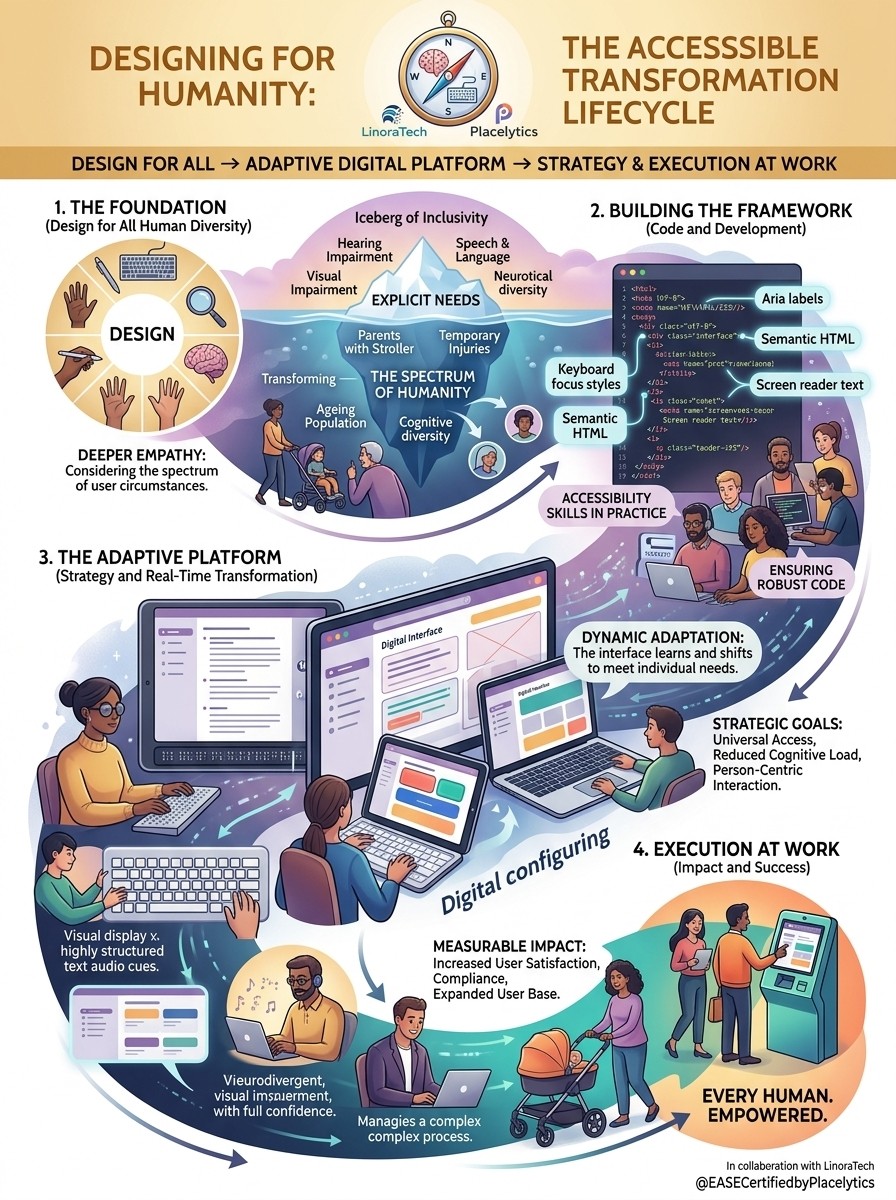
When a board looks at accessibility and sees only cost and compliance, they are voluntarily excluding themselves from a $13 trillion global market. That is not prudent risk management. That is strategic negligence.
Nabil’s Core Message — and the Picture Becomes Transformational
As Nabil’s message here is not just a moral imperative but a business-critical strategic insight:
A person with a real disability who owns the business vertical — who holds executive authority, budget ownership, procurement power, and strategic decision-making responsibility — can see what non-disabled leadership cannot.
Not because non-disabled leaders are incapable of empathy or intelligence. But because lived experience produces pattern recognition, market intuition, and user empathy that no amount of consulting reports, advisory panels, or persona workshops can replicate.
When a leader with a disability owns the accessibility vertical — truly owns it, with authority, budget, and accountability — here is what changes:
Strategic Long-Term Vision
- Product roadmaps shift from “remediate what’s broken” to “design for the full spectrum of human ability from day one” — which produces better products for everyone , not just people with disabilities (the curb-cut effect)
- Market strategy expands to actively pursue the 1.3 billion-person global disability market as a growth opportunity , not an afterthought
- Brand positioning evolves from “we comply with accessibility laws” to “we are the brand that 16% of the world’s population trusts because we were built with them, by them, for them”
- Innovation pipelines unlock entirely new product categories, service models, and customer experiences that non-disabled leadership simply does not see — because they have never needed to navigate the world through that lens
- Partnership and procurement strategies open doors to disability-owned businesses, disability-led organizations, and government contracts with disability inclusion requirements — expanding the revenue pipeline
Tactical Short-Term Wins
- Conversion rates increase immediately when digital experiences are accessible — because accessible design is clearer, faster, and more usable for all users
- Customer acquisition costs decrease when your product is usable by 100% of the population instead of 84%
- Legal exposure drops — not because you’re checking compliance boxes, but because you’ve built accessibility into the DNA of your product and organization
- SEO performance improves — accessible websites consistently rank higher because the same practices that make content accessible (semantic HTML, clear structure, descriptive alt text, logical navigation) are the same practices that search engines reward
- Employee retention and engagement improve — organizations that demonstrate genuine commitment to disability inclusion (not performative inclusion, but structural inclusion with disabled leaders in positions of authority) attract and retain top talent across all demographics
The Revenue Multiplier
Here is the insight that should keep every CFO and board member awake at night:
An organization that moves a leader with a real disability into ownership of the accessibility and inclusive design vertical — with genuine authority, genuine budget, and genuine strategic influence — is not making a charitable gesture. They are installing a leader who can see a $13 trillion market that their current leadership is blind to.
That leader can potentially double the addressable market for the organization’s products and services. Not theoretically. Practically. Because they understand the needs, the pain points, the workarounds, the aspirations, and the purchasing behaviors of 1.3 billion potential customers — from the inside.
That is not a cost center. That is a revenue engine.
What Needs to Change — Practically
Someone may ask who benefits from disabled people remaining outside the rooms where power is exercised. The answer is: no one. Not even the people who think they benefit.
Organizations that keep disabled leadership outside the room are not protecting their bottom line. They are shrinking it. They are voluntarily blind to the largest underserved market in human history.
Here is what I believe needs to happen — and what I advocate for through my work, my TEDx talk on Digital Accessibility, my book Professional UX & Accessibility Designer , and my innovation work on ELIO SmartAdapt (an AI/ML-enabled Smart Adaptive Wheelchair):
- Reframe accessibility in the boardroom — from a compliance cost to a market expansion strategy. Every board presentation on accessibility should include market size, revenue opportunity, and competitive positioning alongside compliance status and remediation costs.
- Appoint disabled leaders to positions of genuine authority — not advisory roles, not panel positions, not “lived experience consultants” — but executive roles with budget ownership, hiring authority, strategic decision-making power, and P&L accountability. As Nabil says: leadership is authority, leadership is ownership, leadership is power.
- Measure what matters — track not just WCAG conformance scores, but revenue from accessible products, customer acquisition from disability markets, market share gains, and innovation output from inclusive design practices. What gets measured gets funded.
- Build accessibility into the product from the foundation — not as a remediation layer applied after launch. This is where Human-Centered Design and inclusive design principles become essential. When you design for the full spectrum of human ability from the start, you build better products for everyone — and you access a market that your competitors are ignoring.
- Invest in disabled entrepreneurship and disability-owned businesses — in procurement, partnerships, and supply chains. The economic empowerment of people with disabilities is not separate from the business opportunity. It is the business opportunity.
Final Thought
Nabil, in the post wrote: “Nothing About Us Without Disabled Leadership.“
I would add: Nothing about the future of business without recognizing that 1.3 billion people are not a compliance obligation — they are the largest underserved market opportunity in the history of global commerce.
The organizations that understand this — and that have the courage to put disabled leaders in positions of genuine authority to capture this opportunity — will not just be more inclusive.
They will be more profitable, more innovative, and more resilient.
The table doesn’t just need more seats. It needs new owners who can see what the current owners cannot. And the ROI of that leadership transition is not incremental. It is transformational.
#WeAreBillionStrong #DisabilityLeadership #AccessibilityIsOpportunity #InclusiveDesign #HumanCenteredDesign #NothingAboutUsWithoutUs #DisabilityInclusion #DigitalAccessibility #A11y #PwD #DEI #InclusiveLeadership #AccessibilityROI
Harish Beeram is the Chief Product & Accessibility Officer of Solutions UIUX Inc, a TEDx speaker on Digital Accessibility, author of Professional UX & Accessibility Designer, creator of PXI (Product Experience Index), innovator behind ELIO SmartAdapt (AI/ML-enabled Smart Adaptive Wheelchair), and a 2024 Marquis Who’s Who in America Honored Listee. He has led human-centered design and accessibility initiatives across SMB, small & large enterprises and some of fortune 500 companies.
Recent Comments